
Zero trust architecture needs the device and network visibility that network access control provides. Removing NAC too early leaves unmanaged devices invisible, weakening the very policies zero trust is meant to enforce.
Zero-trust architecture is often seen as the next step for businesses looking to strengthen their cybersecurity. The idea is simple: trust nothing by default, verify everything, and grant access only when certain conditions are met. Yet, the path from traditional network access control to zero trust is not as straightforward as it might seem.
Many organizations move quickly to adopt zero trust, hoping to solve problems that perimeter-based security models could not. But in the rush, some skip over the foundational elements that make zero trust effective. One of those elements is the visibility provided by network access control, which helps you see every device connected to your network.
Zero trust security is built on the idea that every access request, whether it comes from inside or outside your network, must be authenticated and authorized. This approach promises to reduce the risk of unauthorized access and data breaches. But without a clear view of all devices, zero trust policies can miss threats hiding in plain sight.
If you’re considering a shift to zero trust in Atlanta, it’s worth asking what you might lose if you drop network access control too soon. The answer could shape your entire security posture.

When you move toward zero trust, you’re told that the old idea of a trusted internal network is outdated. Instead, every user or device must prove its identity before access is granted. But to enforce these rules, you first need to know what’s on your network.
Network access control (NAC) gives you this visibility. It helps you identify, monitor, and manage every device that connects, whether it’s a company laptop or an unmanaged phone. Without this foundation, your zero trust security model can’t reliably enforce policies because it doesn’t know what’s out there.
If you skip NAC, you risk leaving gaps. Devices that aren’t managed or properly identified can slip through, making it hard to apply zero trust principles consistently. This is especially true in environments where employees bring their own devices or where IoT devices are common.
The result is a security model that looks strong on paper but has blind spots in practice. Those blind spots can become entry points for attackers, undermining your efforts to minimize the risk of unauthorized access.
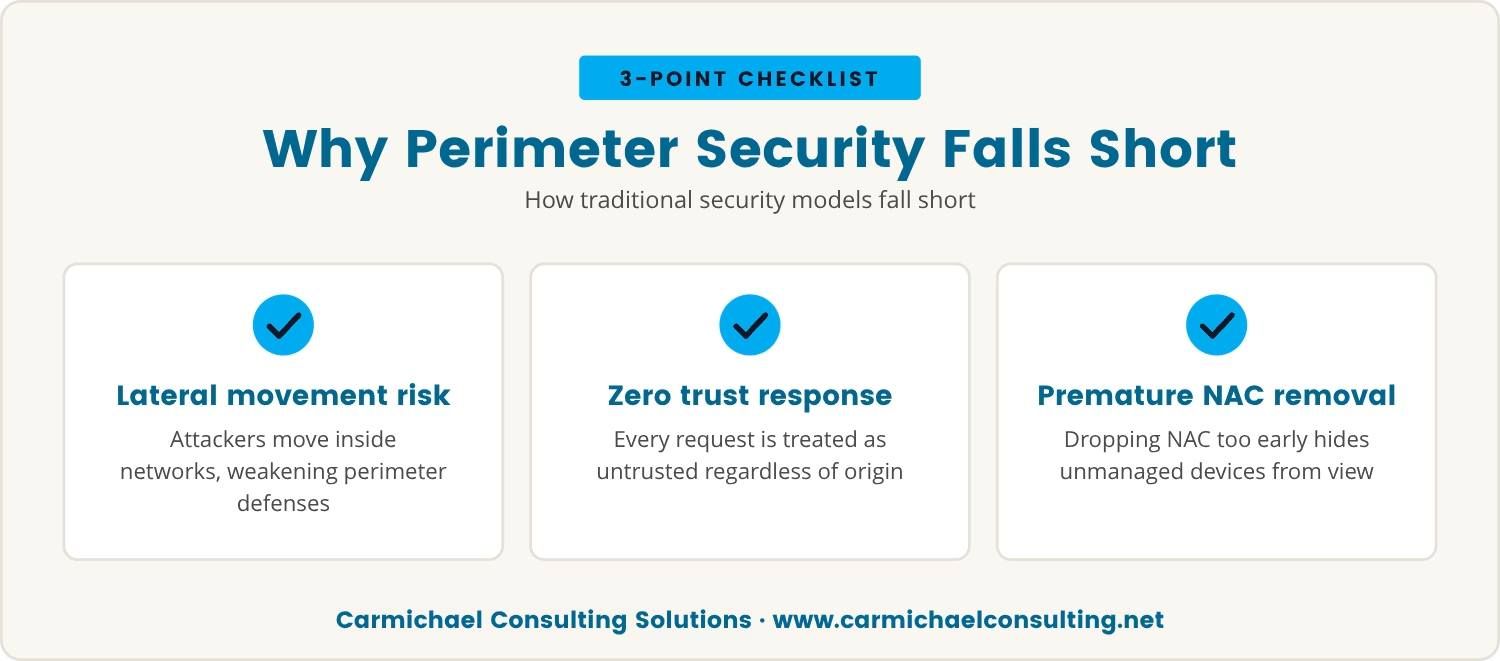
Traditional security models rely on a strong perimeter. Firewalls, VPNs, and other tools are used to keep threats out and trust what’s inside. But attackers have found ways to move laterally within networks, making these models less effective.
Zero trust was designed to address these weaknesses by treating every request as untrusted, no matter where it originates. However, the transition from perimeter-based security to zero trust isn’t just about adding new tools. It’s about changing how you see and control your environment.
If you remove NAC before your zero trust architecture is mature, you lose the ability to see unmanaged devices. These devices can become weak points, especially if they’re not subject to the same authentication and authorization checks as managed endpoints.
A mature zero trust journey requires more than just segmenting the network or adding new security tools. It demands a complete understanding of what’s connected, how it behaves, and what access it really needs.
Zero-trust architecture depends on accurate, real-time information about every device and user. NAC provides this by enforcing policies at the point where devices connect to the network.
With NAC in place, you can:
Without NAC, your zero trust policies may only apply to devices you already know about. Unmanaged or rogue devices can remain invisible, bypassing the very controls you’re trying to enforce.
Microsegmentation is a core zero trust technique. It breaks the network into isolated segments, limiting how far an attacker can move if they get in. But segmentation is only as effective as your ability to see and control what’s inside each segment.
If you lack device visibility, microsegmentation can create a false sense of security. You might think you’ve contained threats, but unmanaged devices can still cross boundaries if they’re not detected by your controls. This is especially risky in environments with many types of endpoints.
For businesses in Atlanta, where remote work and cloud adoption are common, the mix of devices is constantly changing. Without NAC, your segmentation strategy may leave gaps that attackers can exploit.
Some organizations believe that once they start implementing a zero trust network, they can phase out NAC. But dropping NAC too early can have unintended consequences.
Each of these risks can undermine your zero trust adoption and leave your organization exposed.
A mature zero trust security model doesn’t just rely on new technology. It builds on existing controls, like NAC, to create a layered defense.
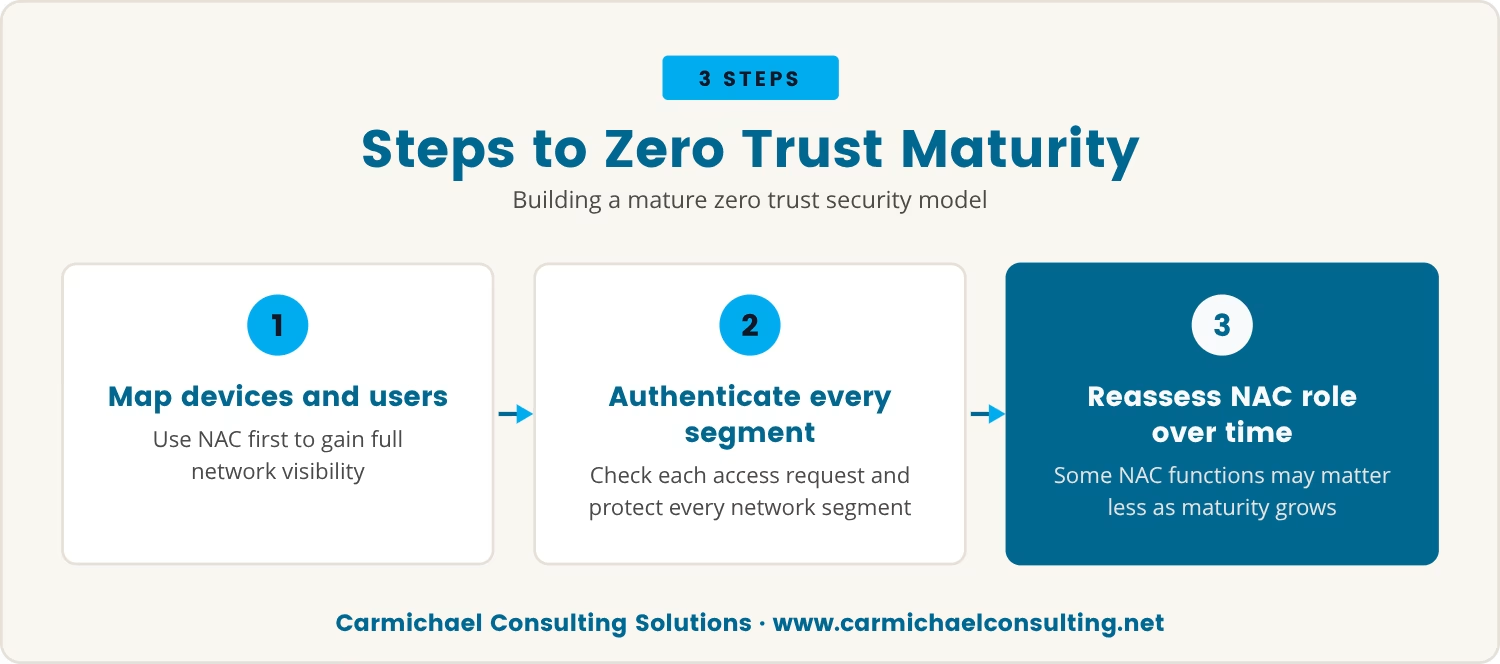
Start by mapping every device and user, using NAC to gain full visibility. Then, apply zero trust principles—like least privilege and continuous verification—across your environment. This approach ensures that every access request is checked, every device is authenticated, and every segment is protected.
As your zero trust journey progresses, you may find that some NAC functions become less central. But until your architecture can provide the same level of visibility and control, removing NAC creates more problems than it solves.
If you’re not sure whether your current setup is ready for this shift, ask yourself: Can you see and control every device that touches your network, or are there blind spots you haven’t addressed?
For organizations in Atlanta, the move to zero trust is both a challenge and an opportunity. The city’s diverse business landscape means that every network is different, with its own mix of devices, users, and risks.
By keeping NAC in place while you implement zero trust, you protect yourself from the gaps that can appear during the transition. This layered approach helps you maintain compliance with organizational policies and reduces the risk of unauthorized access.
Zero trust architecture requires patience and careful planning. Rushing the process or skipping foundational steps can leave you exposed to the very threats you’re trying to prevent.
Zero trust means treating every request as untrusted until proven otherwise. But you can’t verify what you can’t see. Network access control gives you the visibility needed to enforce zero trust principles across your environment.
Dropping NAC before your zero trust architecture is mature can leave unmanaged devices invisible to your policies. The safest path is to keep NAC in place until your new model can match its visibility and control.

Many businesses with 10 to 350 employees are eager to move to zero trust, but the transition can expose hidden gaps if you drop network access control too early. At Carmichael Consulting Solutions, we’ve seen how easy it is to miss unmanaged devices when visibility tools are removed too soon.
If you’re weighing your next steps, we invite you to look at how we approach network visibility and zero trust together—or to start a conversation about your current environment and the risks you want to avoid.
Get a FREE $2,500 Cybersecurity Audit to uncover hidden risks and see how your current network access control supports your zero trust plans.
Network access control helps you identify and manage every device on your network. This visibility lets you create isolated segments based on device type, user role, or other factors. By knowing exactly what’s connected, you can enforce rules that keep sensitive data and systems separated, making it harder for attackers to move laterally if they gain access.
Traditional security models rely on a strong perimeter, trusting everything inside the network. Zero trust, on the other hand, assumes no device or user is trusted by default. Every access request must be verified, regardless of where it originates. This shift reduces the risk of unauthorized access and helps protect against threats that bypass the perimeter.
You can start implementing zero trust principles without NAC, but your security will be limited. Without NAC, you may not see all devices on your network, especially unmanaged or rogue endpoints. This lack of visibility makes it difficult to enforce zero trust policies consistently and increases your risk of security incidents.
Many regulations require organizations to control and monitor who and what accesses sensitive data. Device visibility, provided by NAC, helps you prove that only authorized devices can connect to your systems. This makes it easier to demonstrate compliance during audits and reduces the risk of penalties for non-compliance.
A mature zero trust setup lets you see, control, and authenticate every device and user, no matter how they connect. If you can confidently identify all endpoints, enforce least-privilege access, and monitor activity in real time, you may be ready to phase out NAC. Until then, keeping NAC in place helps close gaps that could otherwise be exploited.
After almost 15 years working in corporate Information Technology in Atlanta, Georgia, Tyler Jones left his role as Vice President of Service Operations with a national payroll provider in 2011 to start Carmichael Consulting Solutions, LLC.