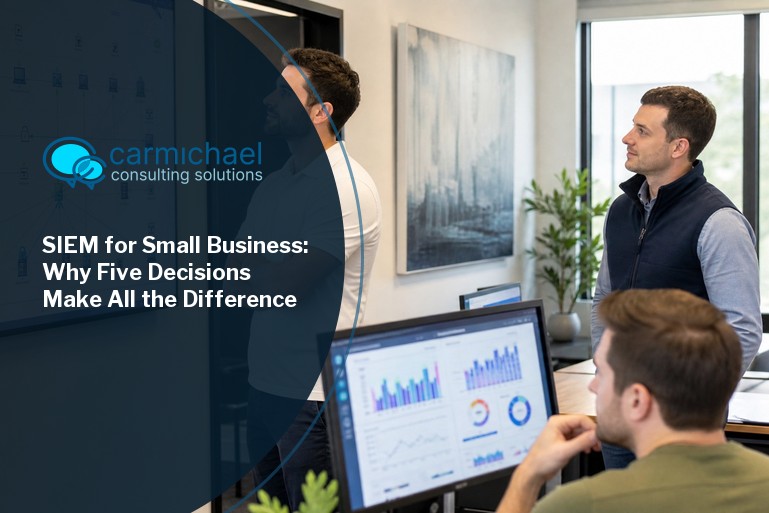
A SIEM only delivers real protection when five decisions—about data, retention, staffing, escalation, and review—are made before and during deployment. Skipping any of them turns your SIEM into a passive archive instead of an active security tool.
Most people treat SIEM for small business as something you flip on - connect the systems, pull in the logs, and the threats surface by themselves. In practice, the outcome rides almost entirely on choices made before the first log ever lands.
A SIEM tool pulls data from across your systems, flags unusual activity, and gives you a shot at responding before damage spreads. For a small or mid-sized operation, the gap between catching a threat early and missing it outright often comes down to a handful of decisions made up front, not the software itself.
Those decisions - what to collect, how long to hold it, who actually watches it - decide whether the system becomes a working defense or a quiet archive nobody opens. Skip them, and you've built a very expensive filing cabinet.

Turning a SIEM on is the easy part; the harder part is making sure it actually sees the threats that matter to your business.
Connect every system you own, and you'd think you'd get full coverage. Instead, you get a flood - alerts piling up faster than anyone can sort real risk from routine noise. The fix is choosing data sources deliberately: logs from your firewall, your endpoints, and cloud platforms like Microsoft 365 or Google Workspace tend to carry the clearest signal.
Collect without a plan, and the noise buries you before a real alert gets a look. Pick the right sources instead, and you see what matters while the rest stays out of the way - which is exactly the discipline that keeps cost and effectiveness in balance for a business weighing a security budget in Atlanta.
How long you keep SIEM data shapes both your costs and your ability to look backward when something goes wrong.
Hold logs too briefly, and you're blind the moment you need history to investigate an incident. Keep everything indefinitely instead, and storage costs climb while the system itself slows under its own weight.
Most small businesses land somewhere in the middle - enough retention to meet compliance and support an investigation, not so much that performance suffers. That balance isn't fixed either; it's worth revisiting as the business grows or regulations shift.
Compliance adds another layer, since some industries require specific logs held for a set period, so the SIEM platform you pick needs to support that without overloading storage.
A SIEM system only pays off once five specific decisions get made before and during deployment, and skipping any one of them turns the tool into a passive log archive rather than an active defense.
Decide up front which systems send logs to the SIEM, favoring firewalls, endpoints, and cloud services where attack signs usually surface first. Too many sources drown you in noise; too few leave blind spots exactly where you can't afford one.
Set a retention period that satisfies compliance and supports investigations, without holding data the SIEM doesn't need. Push past that point and the tool slows down instead of helping.
Someone has to watch the dashboard and act on what it flags, or the alerts simply pile up unseen. Even a small operation needs that responsibility assigned somewhere, whether it's an internal role or outside managed support.
Not every alert deserves a response, but missing the one that does can be costly, so the line between the two needs to be written down. Document it clearly enough that everyone on the team reads it the same way.
Put a schedule around reviewing alerts and system performance, since threats shift and rules drift out of date if nobody checks. That's especially true for a business running without a full security operations center behind it.
Even a well-built SIEM is only as sharp as the person watching it, because without someone assigned, alerts just become background noise most teams tune out.
For a small or mid-sized business, that usually means folding SIEM monitoring into someone's existing role or leaning on a managed security partner to carry the load. Our own helpdesk and security operations center run 24/7/365 with local staff, which is one way of answering that staffing question without stretching an internal hire too thin.
Escalation rules matter just as much, since without them, people either ignore real alerts or chase false positives all day. Spelling out what counts as a genuine incident - and when it gets escalated - is what keeps the team's attention on what's actually worth it.
We've landed on an instinct here, more sure than not, that security and operations work - not the heavier custom development side of IT - is where a shop like ours actually earns its keep.
That's not a claim to being the strongest outfit on every front; development-heavy projects aren't where we'd put our best people forward, and saying otherwise would be stretching the truth. Staffing and escalation sit inside that same strength - it's operational discipline, not a security identity we're trying to wear, that makes the difference.
If it's not clear who owns this at your business, it's worth asking: who handles security event response today, and do they actually have the time and training to manage SIEM alerts on top of everything else?
A SIEM system needs steady attention or it stops being useful, and setting a review cadence is how that attention gets scheduled - daily or weekly, depending on the size of the operation.
Skip the schedule, and things slip: threats go unnoticed, rules drift out of date, and the system misses attack patterns it was built to catch. Regular review keeps it tuned to your actual environment instead of a generic one.
Automation helps flag suspicious behavior faster than any person could, but it doesn't replace someone deciding what to do next - that part still needs a human attached to it.
Skip any one of these five decisions and the SIEM's value drops fast. Without the right data sources, threats slip past unseen; without retention, there's nothing left to investigate; without staffing and escalation rules, alerts sit unanswered; and without a review cadence, the whole system turns into another piece of software collecting dust.
The cost isn't just the wasted technology spend - it's the exposure that comes with missing something real. For a business weighing that risk, in Atlanta or anywhere else, the gap between an active defense and a passive archive comes down to exactly those choices.

If your business has 10 to 350 employees, you may be weighing how to get more from your SIEM investment or wondering if you’re missing something critical. At Carmichael Consulting Solutions, we see many companies in your position—looking for a way to turn security tools into real protection, not just another IT expense.
We invite you to see how we approach SIEM planning and monitoring, or to start a conversation about your own environment. Sometimes, a quick review is all it takes to spot what’s holding your defenses back.
Get a FREE $2,500 Cybersecurity Audit if you qualify as a small or mid-sized business—see where your SIEM stands and what to improve.
Start by narrowing data sources to the ones that matter most, typically the firewall and endpoint devices, rather than connecting everything available. Tune correlation rules to cut down false positives, and revisit which alerts actually get used - that discipline keeps the system focused on real threats instead of noise.
A SOC is the team or service watching for, catching, and responding to security incidents as they happen. Most small businesses don't run a dedicated SOC in-house, so the gap usually gets filled by assigning monitoring to an existing staff member or contracting managed security operations center services.
Threat hunting means actively searching for signs of compromise rather than waiting for an automated alert to fire. A SIEM supports that work by pulling together and correlating log data, which makes patterns easier to spot - and regular hunting tends to catch what automated rules alone would miss.
Yes - cloud platforms like Microsoft 365 generate their own kind of log data and security events, distinct from on-premises systems. Getting a SIEM to collect and correlate those logs properly, with rules adjusted for cloud-specific risks, is what keeps visibility consistent across both environments.
Reviewing on a fixed schedule - daily or weekly, depending on the business - and updating rules as the environment changes is the core of it. Documenting that process and making sure someone owns the follow-up is what keeps a SIEM active rather than just logging quietly in the background.
After almost 15 years working in corporate Information Technology in Atlanta, Georgia, Tyler Jones left his role as Vice President of Service Operations with a national payroll provider in 2011 to start Carmichael Consulting Solutions, LLC.