A long list of certifications doesn’t guarantee that penetration testing services will catch the vulnerabilities that matter most. Focusing on your real attack surface is what truly reduces risk.
You might be searching for penetration testing services and notice that some providers highlight a long list of certifications. It’s easy to assume that more certifications mean better protection for your business, but the reality is more complex.
A thorough security assessment can still overlook the systems that matter most if it doesn’t match how your company’s technology is actually used. The most valuable insight often comes from understanding your unique attack surface, not just from ticking off credentials.
Penetration testing services are designed to simulate real-world attacks on your network, applications, and infrastructure. The goal is to identify vulnerabilities that could be exploited by hackers. Choosing the right provider is about more than just their qualifications—it’s about how closely their approach fits your environment.

Many businesses look for penetration testers with the most certifications, thinking this guarantees a thorough job. But there’s a difference between broad expertise and relevant expertise.
A provider can have a wall full of certificates but still miss the systems that are most exposed in your daily operations. Attackers don’t care about your provider’s credentials—they care about the easiest way in. That’s why mapping your attack surface is critical.
Your attack surface includes every system, application, and device that could be targeted. If a pen test doesn’t focus on these, it risks leaving real vulnerabilities untested. The best security testing starts by understanding what you actually use, not just what a checklist says to scan.
Certifications show that a tester has passed certain exams or training. They can be useful, but they don’t guarantee that the provider will understand your specific risks.
Some certifications focus on general knowledge or on certain types of systems, like cloud security or network infrastructure. If your business in Atlanta relies heavily on custom applications or unique workflows, a tester’s certifications may not cover those areas.
A pen testing service provider with a long list of credentials might still use a standard approach that misses the systems attackers are most likely to target in your environment. That’s why a tailored assessment is often more valuable than a generic, certification-driven scan.
When you choose penetration testing services, the real value comes from how closely the engagement matches your actual setup. Here’s what to look for:
A provider who understands your business context will uncover risks that a generic, certification-focused approach might miss.
A one-size-fits-all penetration test can leave you with a thick report but little insight into your real security weaknesses. Here’s how a tailored approach makes the difference:
A good tester will spend time learning how your systems are used, who accesses them, and where sensitive data lives. This shapes the test to your actual risks.
Instead of scanning every system equally, a focused test zeroes in on the applications and devices most exposed to attackers. This is where breaches are most likely to start.
A tailored test uses techniques that mimic what real attackers would try against your business, not just what’s on a certification exam.
The report highlights the issues that could actually lead to a data breach, helping you focus your remediation efforts where they matter most.
After the test, the provider should help you understand how to fix the most serious findings, not just leave you with technical jargon.
A strong vulnerability management program depends on more than just a pen test. Here are key steps to make sure your efforts pay off:
These steps help ensure that your security testing leads to lasting improvements, not just a passing grade.
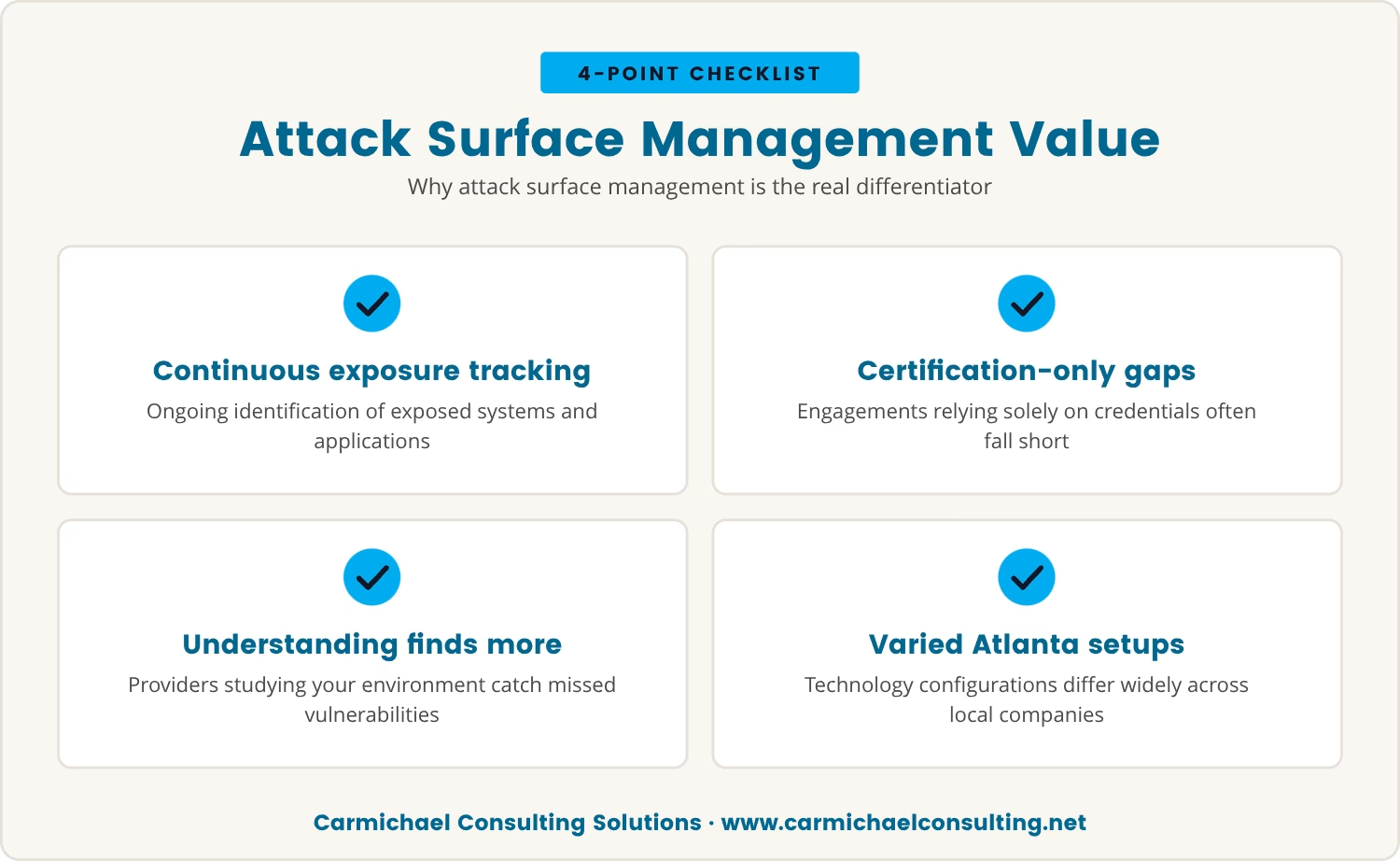
Attack surface management is about continuously identifying and addressing the systems and applications that are exposed to threats. This is where many penetration testing engagements fall short if they rely only on certifications.
A provider that invests time in understanding your unique environment will find vulnerabilities that others miss. This approach is especially important for businesses in Atlanta, where technology setups can vary widely from company to company.
By focusing on your real attack surface, you get a security assessment that reflects your actual risks—not just a generic checklist. This means you’re better prepared to prevent a data breach, even if your provider’s certification list isn’t the longest.
Choosing a penetration testing provider should be about more than collecting certificates. The real test is how well their engagement matches your business’s actual attack surface.
A report that looks impressive on paper won’t help if it misses the systems most likely to be breached. The best results come from a provider who takes the time to understand your environment, tailors the assessment, and supports you in addressing the findings.

For organizations with 10 to 350 employees, it’s easy to feel confident after a thorough security assessment—until you realize it missed the systems you rely on most. At Carmichael Consulting Solutions, we know that a tailored approach makes the difference.
If you want to see how our team maps your attack surface and delivers actionable results, let’s talk about your current setup and how we can help you address the risks that matter.
Qualified businesses can receive a FREE $2,500 Cybersecurity Audit to help uncover vulnerabilities that matter most to your operation.
Most businesses benefit from scheduling a penetration test at least once a year, or whenever there are major changes to their systems or applications. Regular testing helps ensure that new vulnerabilities are identified and addressed before attackers can exploit them.
A vulnerability assessment scans your systems for known weaknesses, while a penetration test goes further by actively trying to exploit those weaknesses to see how far an attacker could get. Both are important, but a penetration test provides a deeper look at your real security gaps.
Certifications show that a provider has certain skills, but they don’t guarantee that the assessment will match your specific environment. The most effective security testing comes from understanding your unique risks and tailoring the approach to your business.
Look for a provider who takes time to understand your systems, clearly defines the scope of the engagement, and provides actionable recommendations. Experience with businesses similar to yours is often more valuable than a long list of certifications.
Attack surface management helps you continuously identify and address the systems and applications most exposed to threats. By keeping your attack surface up to date, you reduce the chances of missing critical vulnerabilities that could lead to a breach.
After almost 15 years working in corporate Information Technology in Atlanta, Georgia, Tyler Jones left his role as Vice President of Service Operations with a national payroll provider in 2011 to start Carmichael Consulting Solutions, LLC.