%20(1).jpg)


Artificial intelligence is becoming part of everyday business operations. Employees are using AI tools to draft emails, summarize meetings, organize ideas, review documents, create content, and speed up repetitive tasks. For many companies, these tools can improve productivity and help teams move faster.
However, AI also creates legal, security, and compliance risks when it is used without clear rules. A simple prompt can include confidential business plans, employee details, customer information, financial data, contracts, or legal questions. Once that information is entered into the wrong AI tool, the company may lose control over where it goes, how it is stored, and whether it can be protected later.
This is why AI legal compliance should be part of every business technology strategy. Companies need to know which AI tools employees can use, what information should never be entered, and when human review is required. AI should not be treated as a private notebook, a legal advisor, or a replacement for secure business systems.
Recent discussions around AI attorney-client privilege make this even more important. A Frier Levitt article on United States v. Heppner explained that a federal court ruled documents created with a consumer AI chatbot were not protected by attorney-client privilege or the work product doctrine. For business leaders, this is a clear reminder that AI use must be supported by policies, secure tools, and proper oversight.
Carmichael Consulting Solutions helps businesses approach technology decisions with a practical, security-focused mindset. AI can support productivity, but it should be used in ways that protect sensitive data, reduce risk, and support responsible decision-making.

The legal implications of AI begin with data. Every time an employee enters information into a generative AI platform, that information may be processed under the platform’s terms of service and privacy policy. Some tools may store prompts, review outputs, use information to improve models, or share data under certain conditions. If employees do not understand these terms, they may accidentally expose sensitive information.
This creates several concerns for businesses. Confidential information may be entered into an unapproved tool. Customer data may be handled in a way that violates internal policy or legal requirements. Internal strategies may be shared with platforms that do not guarantee confidentiality. AI-generated content may also include inaccurate, misleading, or unsupported information.
The legal implications of AI also include accountability. If an employee uses AI to create a customer-facing statement, summarize a contract, or make a recommendation, the business may still be responsible for the final result. AI can assist with drafting and research, but it does not remove the need for professional judgment.
Businesses should also consider whether AI use could affect contracts, intellectual property, employment decisions, privacy obligations, or industry regulations. A tool that seems harmless for general writing may create problems when used with sensitive or regulated information.
For companies that need stronger structure around compliance and risk, IT audit and compliance services can help identify gaps, review systems, and support a more proactive approach to protecting sensitive information.
AI attorney-client privilege is one of the most important issues businesses should understand before employees use AI for legal topics. Attorney-client privilege generally protects confidential communications between a client and an attorney when those communications are made for the purpose of seeking or receiving legal advice.
A consumer AI chatbot does not become part of that relationship simply because someone asks it a legal question. It is not an attorney, it does not provide legal representation, and it may not maintain confidentiality in the way privilege requires. This means employees should not assume AI-generated legal notes, summaries, or strategy documents are protected.
For example, an executive may ask an AI tool to summarize a vendor dispute. A manager may paste details about an employee issue and ask for advice. A finance leader may enter information from an attorney’s email and ask AI to create a response. These actions may feel efficient, but they can create legal exposure if privileged or confidential information is shared with an unapproved third-party platform.
The concern is not only the AI output. The prompt itself may contain sensitive information. If an employee enters attorney advice, internal investigation notes, litigation strategy, or confidential legal communications, the company may risk weakening privilege protections.
Businesses should make this rule clear: employees should not use public or consumer AI tools for legal strategy, attorney communications, litigation matters, internal investigations, or privileged information. When legal analysis is needed, it should go through the proper legal channel.
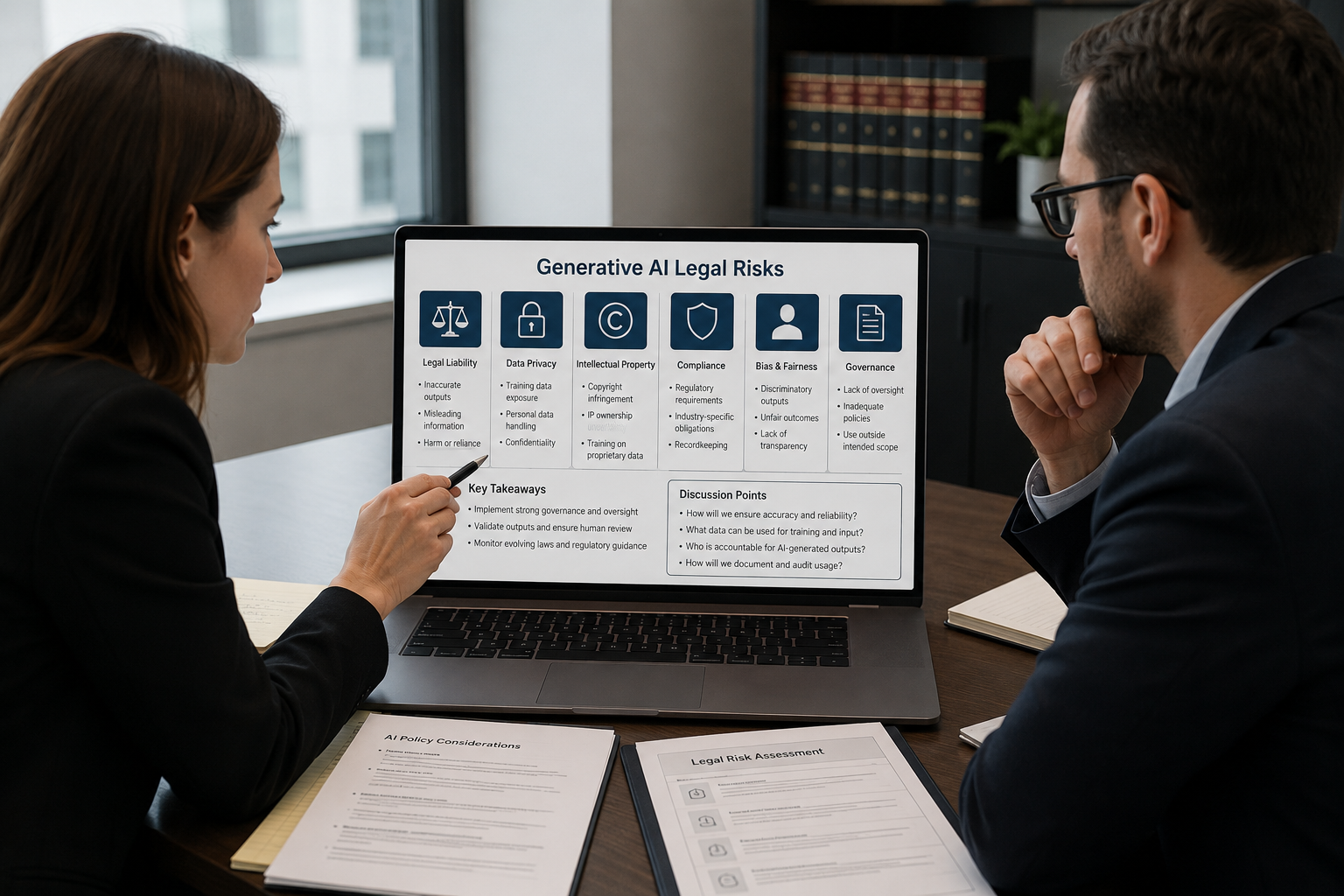
Generative AI legal risks can affect many parts of a business. One of the biggest risks is confidentiality. Employees may not realize that client names, pricing details, vendor information, internal processes, and private business plans can all be sensitive. If that information is entered into an unapproved AI platform, the company may not be able to fully control what happens next.
Another risk is accuracy. AI tools can produce polished answers that sound correct but may be incomplete, outdated, or wrong. This is especially risky when employees rely on AI for legal, financial, technical, or compliance-related work. A confident answer is not the same as a verified answer.
There are also intellectual property concerns. AI-generated content may be difficult to trace back to original sources, and some outputs may resemble existing materials. Businesses using AI for marketing, software development, design, training materials, or client deliverables should have review steps in place before publishing or sharing work.
Privacy is another major issue. If employees enter customer records, employee information, health data, financial details, or other sensitive data into AI tools, the company may face compliance problems. This is especially true for businesses in regulated industries or companies that handle confidential client information.
Generative AI legal risks also include poor decision-making. AI can help organize information, but it should not make final decisions about hiring, discipline, contracts, security, compliance, or legal strategy without human oversight. Businesses should clearly define where AI can assist and where trained professionals must make the final call.
A business AI policy should be clear, practical, and easy for employees to follow. If the policy is too broad, employees may not know what is allowed. If it is too strict, employees may ignore it or use AI without approval.
The policy should start by identifying approved AI tools. Employees should know which platforms are safe for business use and which ones are not allowed. This helps prevent employees from using personal accounts, free tools, or consumer platforms for sensitive work.
The policy should also explain acceptable use cases. For example, employees may be allowed to use AI for brainstorming general ideas, improving non-confidential writing, creating outlines, summarizing public information, or organizing internal notes that do not contain sensitive data.
It should also list prohibited information. Employees should not enter passwords, customer records, employee files, legal advice, contracts, financial data, trade secrets, source code, confidential client information, or regulated data into unapproved AI tools.
Human review should be part of the policy. AI-generated work should be checked before it is used in customer communications, legal documents, technical instructions, HR materials, financial decisions, or compliance-related content. Employees should understand that AI can help with a draft, but it should not be treated as the final authority.
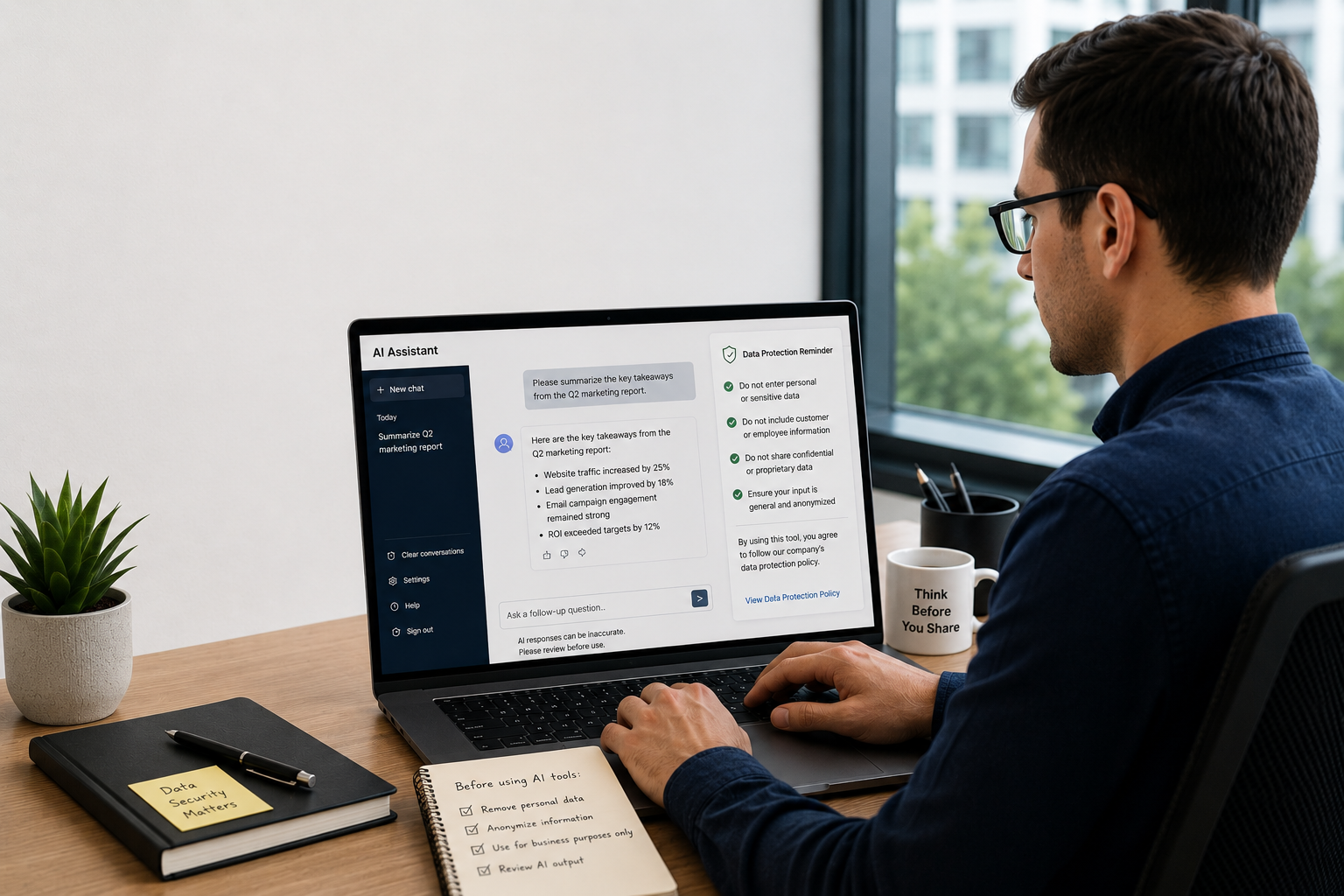
Enterprise AI tools may offer stronger protections than consumer platforms, but businesses should still review them carefully. Not all AI tools provide the same level of privacy, security, or contractual protection. Before approving a tool, companies should understand how it stores data, whether prompts are used for model training, who can access information, and how long data is retained.
Security controls can also help support AI legal compliance. Businesses should use access management, role-based permissions, single sign-on, monitoring, and data loss prevention tools when possible. These controls help reduce the chance that sensitive information is copied into unapproved platforms.
Companies should also decide who is responsible for AI oversight. IT may manage security settings and access. Legal may review contracts and privilege concerns. HR may help train employees. Leadership may approve the overall policy. When these teams work together, AI governance becomes stronger.
Businesses that want stronger monitoring and protection around sensitive systems can also explore managed IT security services. This type of support can help companies strengthen cybersecurity, monitor threats, and build safer processes around business technology.
Documentation also matters. Businesses should keep records of approved tools, vendor reviews, employee training, policy updates, and risk assessments. If a problem occurs later, documentation can help show that the company took reasonable steps to manage AI use responsibly.
Before adopting an AI platform, businesses should review the vendor’s terms carefully. This step is often skipped because AI tools are easy to start using. However, easy access does not always mean the tool is safe for business use.
Vendor review should include questions about confidentiality, data ownership, data retention, model training, third-party sharing, breach response, and user access. Businesses should also ask whether the vendor offers enterprise-level protections and whether those protections are included in the agreement.
The consumer-versus-enterprise distinction is especially important for sensitive use cases. Consumer AI tools may not provide the confidentiality protections a business needs. Enterprise agreements may offer stronger terms, but they should still be reviewed before employees use the tool for confidential or legal work.
Legal and IT teams should work together during this process. Legal can review contract language and risk. IT can review security, access, integrations, and technical controls. This combined review helps ensure the tool supports business goals without creating unnecessary exposure.
Vendor review is not just a one-time task. AI platforms change quickly, and terms may be updated. Businesses should review important tools regularly to make sure they still meet company requirements.

Even the best AI policy will not work if employees do not understand it. Training should explain AI legal compliance in simple terms and show employees what safe use looks like in everyday work.
Training should cover what information is considered confidential, which tools are approved, when employees need permission, and what types of prompts are risky. Employees should also learn that AI output can be wrong, even when it sounds professional.
For example, a safe prompt might ask AI to create a general outline for a blog topic without including client data. A risky prompt might include customer names, contract details, legal advice, or private financial information. These examples help employees make better decisions.
Training should also explain AI attorney-client privilege concerns. Employees should know not to enter attorney advice, legal questions, litigation details, or internal investigation information into consumer AI tools. This is especially important for managers, executives, HR teams, and anyone handling sensitive business matters.
Ongoing reminders can help keep AI compliance visible. AI use is changing quickly, so businesses should update training as tools, policies, and risks evolve.
AI governance does not need to be complicated. Growing businesses can start with a few practical steps. First, identify how employees are already using AI. Many companies discover that staff members are using AI tools before a formal policy exists.
Second, classify business data. Leaders should know which information is public, internal, confidential, regulated, or legally sensitive. This makes it easier to decide what can and cannot be entered into AI systems.
Third, choose approved tools and communicate them clearly. Employees are more likely to follow policy when they have safe options available. If companies only say no without offering approved alternatives, employees may continue using unapproved tools.
Fourth, assign responsibility. Someone should own the AI policy, review tool requests, update training, and monitor new risks. This responsibility may sit with IT, operations, legal, or leadership, depending on the size and structure of the business.
Some companies may also need higher-level security guidance as AI use expands. Security packages can support areas such as compliance documentation, strategic risk management, oversight, and security roadmaps.
Finally, review the policy regularly. AI tools and legal expectations are changing quickly. A policy created once and forgotten may not be enough. Regular updates help keep AI legal compliance aligned with current business needs.
AI can help businesses work faster, create better processes, and support employees in meaningful ways. However, it also creates legal, security, and compliance risks when used without rules. A simple AI prompt can expose confidential information, weaken privilege protections, or create records that may be difficult to protect later.
AI legal compliance gives businesses a safer path forward. It helps employees understand what is allowed, protects sensitive information, reduces generative AI legal risks, and supports better decision-making. It also helps companies think carefully about AI attorney-client privilege before employees use AI tools for legal topics.
The best approach is practical and balanced. Businesses do not need to avoid AI completely. They need to use it with clear policies, approved tools, employee training, vendor review, and security controls. With the right support, companies can benefit from AI while reducing the risks that come with it.
AI legal compliance is the process of using artificial intelligence in a way that follows legal, privacy, security, and industry requirements. For businesses, this includes approving safe tools, setting employee rules, protecting confidential data, reviewing AI outputs, and updating policies as risks change.
The legal implications of AI include confidentiality concerns, privacy risks, inaccurate outputs, intellectual property issues, regulatory exposure, and possible privilege problems. Businesses should understand how AI tools handle data before employees use them for sensitive work.
AI conversations are not automatically protected by attorney-client privilege. Consumer AI tools are not attorneys, do not provide legal representation, and may not maintain confidentiality. Employees should avoid entering legal advice, litigation details, or privileged communications into public AI platforms.
Common generative AI legal risks include exposing sensitive data, relying on inaccurate information, creating unclear ownership of content, violating privacy obligations, and weakening privilege protections. These risks can be reduced with policies, training, approved tools, and vendor review.
A business AI policy should identify approved tools, acceptable use cases, prohibited information, review requirements, and employee responsibilities. It should also explain when employees must involve IT, legal, HR, or leadership before using AI for sensitive work.


.svg)
-svg.webp)
.svg)